
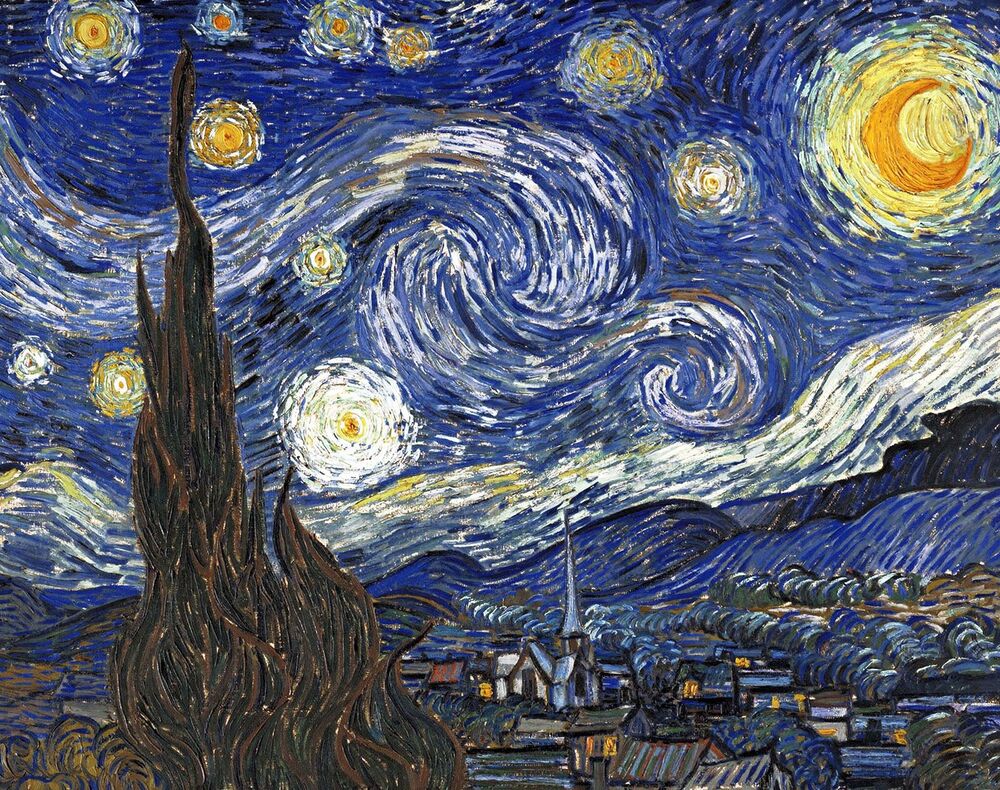

Vincent van Gogh painted one of the world’s most familiar skies, yet the night behind it has never stopped moving. A new study proposes that The Starry Night may draw from the predawn sky of July 22, 1889—several weeks later than the June date traditionally attached to the painting.
The research, published in Scientific Reports, compares the work with astronomical simulations, topography, weather information, drawings and Van Gogh’s letters. Its authors identify a waning crescent moon, Venus and the Hyades star cluster gathered within a narrow eastern view from Saint-Rémy-de-Provence.
The date is a hypothesis, not a newly discovered inscription. Independent experts interviewed by the Associated Press described the argument as plausible but not conclusive. That uncertainty is part of what makes the story compelling: science can reconstruct a sky with precision, but a painting still contains choices that no calculation can fully recover.
Looking from the asylum window
Van Gogh entered the asylum at Saint-Paul-de-Mausole in May 1889. From his room and the surrounding landscape, he studied cypresses, olive groves, hills and changing light. MoMA dates The Starry Night to June 1889 and describes its bright orb left of center as Venus, the morning star.
The new study questions whether the crescent moon and other celestial elements align more convincingly with a later predawn configuration. The researchers use geometric comparison as well as documentary clues, including references in Van Gogh’s correspondence that may fit July conditions.
Even if the proposed date is correct, it would not turn the painting into a literal snapshot. The village is invented rather than copied from the view, and the sky is organized through sweeping curves, repeated halos and compressed space. Observation enters the work, then passes through memory, composition and feeling.
The moon, Venus and a cluster of stars
Astronomical dating works because the sky is both changeable and calculable. The moon’s phase and position shift from night to night; planets move against the stars; a particular view depends on direction, time and place. When several independent features align, researchers can test whether an artist may have observed a specific configuration.
In this case, the proposed grouping appears around dawn on July 22. The Hyades form a recognizable cluster in Taurus, while Venus would have shone with unusual prominence. The study argues that these features fit Van Gogh’s arrangement closely enough to reopen the chronology.
But resemblance is not proof of a single morning. Van Gogh may have combined observations from different times, altered the moon for expressive or symbolic reasons, or worked from drawings and memory. The painting’s power has always depended on the union of the seen and the transformed.
Why the date matters
Moving the likely observation from June to July would change the sequence in which scholars read Van Gogh’s letters, sketches and paintings from Saint-Rémy. It could clarify when he gathered visual material and how long he carried it before completing the canvas. It also strengthens the case that the sky was rooted in sustained observation rather than invented without reference to nature.
The distinction should not be used to diminish imagination. Fidelity and invention are not opposites in Van Gogh’s work. A real planet can become a radiant white center; a cypress can rise like flame; a measured horizon can support a sky that appears to breathe.
A painting that keeps yielding evidence
The Starry Night has attracted physicists studying turbulence, astronomers tracing celestial bodies and art historians examining color, religious thought and modernity. Each approach finds a different structure in the same painted surface.
The new study does not solve the work. It brings one possible morning closer: a waning moon, Venus, a star cluster and an artist awake before sunrise. Between that sky and the canvas lies the mystery that measurement cannot remove—the moment when looking became painting.
The Starry Night, completed in 1889, is in the collection of the Museum of Modern Art in New York.