
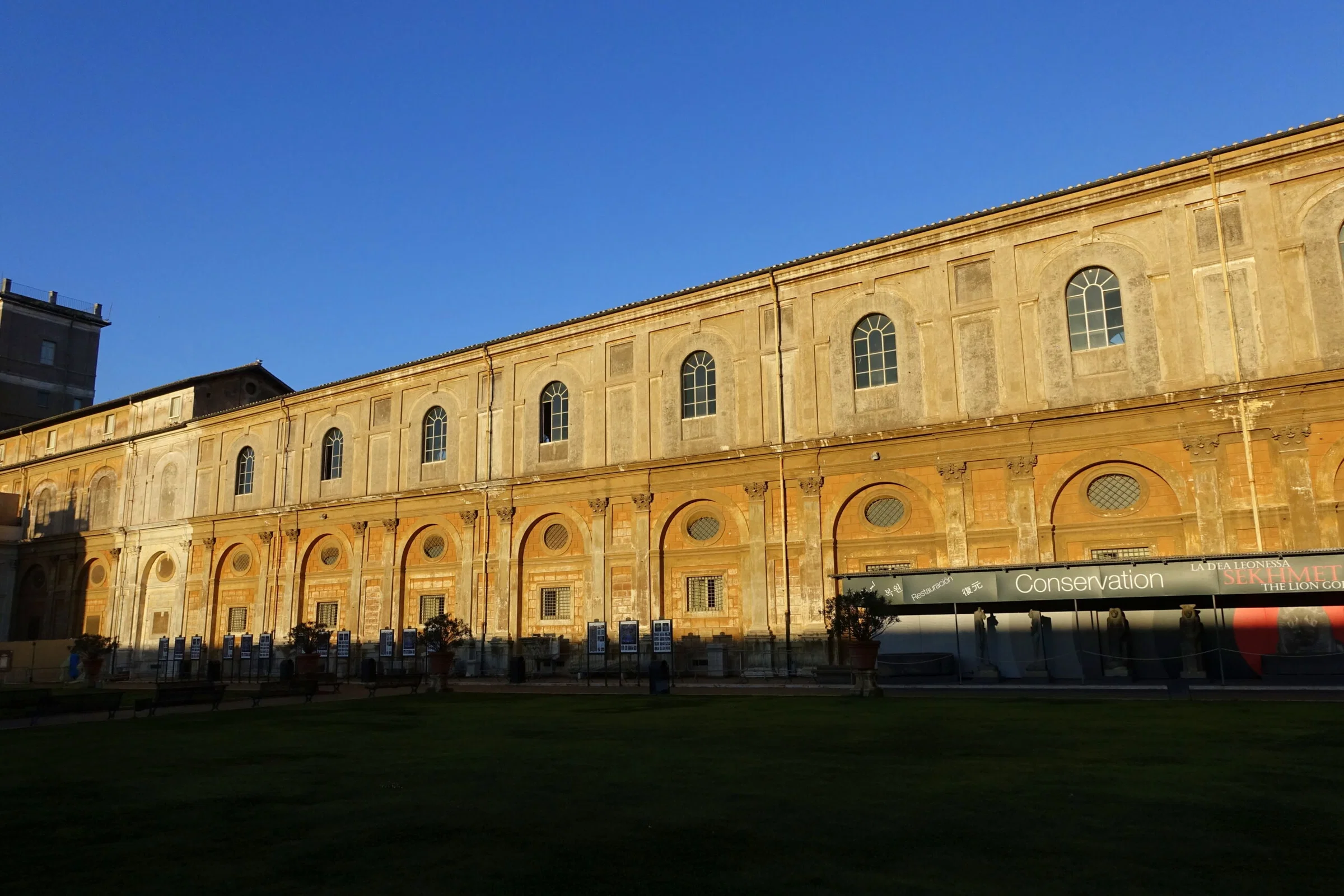

For ten years, conservators at the Vatican Museums worked across a Renaissance courtyard large enough to contain centuries of repair, repainting, weather, and changing taste. When the restoration of the Courtyard of the Pinecone was completed in October, one of its most striking results was also one of the quietest: the return of a pale travertine-colored surface that had long been hidden beneath yellow ochre.
The project began in September 2016 after three pilot campaigns tested different areas and construction phases. The Courtyard’s façades showed deterioration in their plaster and surface layers. Conservators needed to understand not only what had changed, but which historical state could be recovered responsibly.
Reading a building layer by layer
Stratigraphic tests and scientific analysis identified traces of an ivory or travertine-colored whitewash made from lime and marble dust. From the nineteenth century onward, the façades had been painted yellow ochre in keeping with Roman custom. Archival research and historical views helped the team compare material evidence with the courtyard’s earlier appearance.
The decision was not to make the Renaissance look newly built. It was to recover a coherent surface close to the oldest surviving fragments. To do that, the restorers returned, where possible, to traditional mixtures: lime putty, powdered pigments, and cow’s milk.
The presence of milk sounds improbable beside diagnostic laboratories and architectural conservation. Yet it captures the project’s unusual continuity. Historical materials were not reproduced as theater; they were selected because their behavior and appearance helped the new finish relate to the building’s surviving evidence.
A courtyard assembled across centuries
The Courtyard of the Pinecone belongs to the architectural history of the Vatican’s Belvedere complex. Its identity has never been a single frozen moment. Designers, patrons, artists, and later interventions altered how its levels, façades, sculpture, and circulation were understood.
The restoration therefore required many forms of expertise. The Vatican Museums’ architectural heritage department worked with curators, scientific researchers, and laboratories specializing in stone, painting, wood, metal, and ceramics. The final phase included general maintenance of the façades and work on the Portal of Gregory XV and Gio Ponti’s marble staircase.
That institutional breadth is part of the extraordinary story. Conservation at this scale is not one restorer’s revelation. It is an extended chain of observation, sampling, documentation, testing, handwork, and decisions that must remain accountable to the object and to future scholars.
The drama of choosing restraint
Restoration stories are often told through spectacular before-and-after images. The deeper drama here lies in restraint. The team had to decide which later layers were evidence worth keeping, which changes obscured the courtyard’s architectural reading, and how new material could remain visually faithful without pretending to be original.
For artists, the project offers an expansive idea of making. A surface can be created through subtraction as well as addition. Color can emerge from research as much as intuition. Traditional recipes and modern analysis do not have to be opponents; they can test and correct one another.
The restored courtyard is not a return to an untouched past. It is a carefully argued present, built from traces. Lime, milk, marble dust, pigment, archives, and ten years of labor have made the building legible again—while leaving enough evidence for another generation to continue the conversation.