
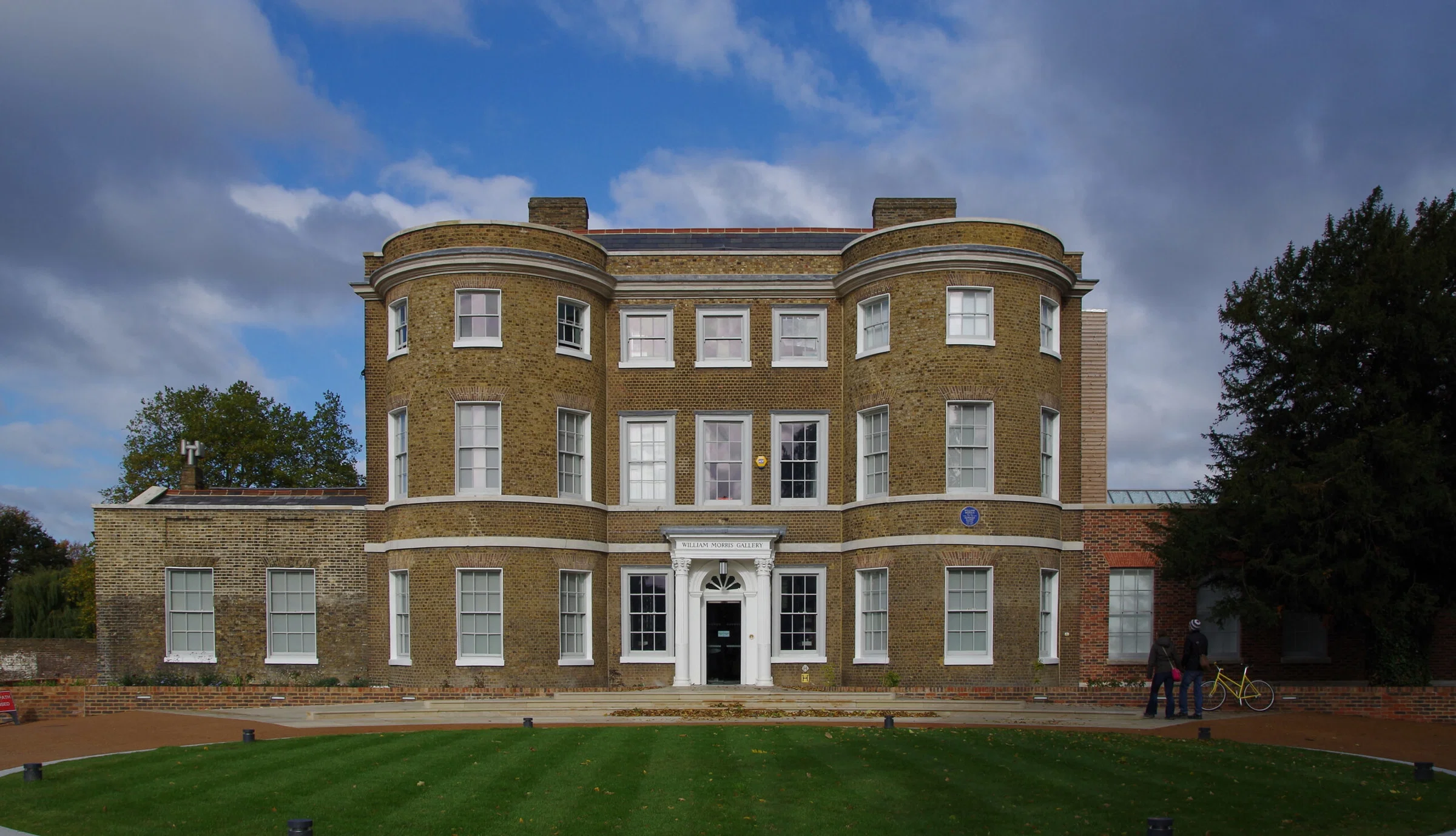

William Morris spent a lifetime arguing that beauty belonged in ordinary life. The museum in his former Walthamstow home has now reopened with a display that makes the same argument about history: it becomes more useful when more people are allowed into the room.
Opening on October 3, the William Morris Gallery’s first major rehang since 2012 arrives in the 130th anniversary year of Morris’s death. The familiar designer, writer, printer, conservationist, and socialist remains present, but the institution has widened the frame around him. Women makers, global visual traditions, political commitments, environmental concerns, and local community voices now shape the story rather than appearing as footnotes.
Moving beyond the solitary-genius story
The new displays give greater visibility to figures including May Morris and Kate Faulkner. That matters because the Arts and Crafts movement was never the work of one man. It depended on workshops, collaborators, skilled labor, family networks, and makers whose names were often less aggressively preserved.
The rehang also addresses the South Asian and Islamic sources that informed Morris’s pattern language. For contemporary artists, the shift offers a valuable model: influence should be researched, named, and interpreted with specificity. A richer account does not diminish an artist’s achievement. It shows how creative languages travel, change, and acquire meaning.
A museum shaped with its neighbors
The gallery developed the new presentation with community input and has introduced displays that connect Morris’s ideas to contemporary questions about labor, access, sustainability, and the environment. This is particularly resonant in Walthamstow, where a historic house is also a civic space serving an exceptionally diverse part of London.
The result points toward a useful future for single-artist and heritage museums. Instead of freezing a celebrated figure inside a fixed biography, an institution can use the archive as a living instrument—one that makes room for contradiction, overlooked collaborators, and the changing questions of its audience.
What artists can take from the reopening
Morris understood that an artistic identity could extend across media: textiles, books, interiors, political writing, conservation, and public advocacy. Today, that interdisciplinary approach feels newly contemporary. Artists working across objects, publishing, teaching, and social practice can recognize the same possibility in their own careers.
But the rehang also suggests a responsibility. Artists and estates should document collaborators, techniques, source cultures, and working relationships while records are still available. Institutions cannot tell a complete story if the archive preserves only the most famous name.
For museums, the lesson is equally practical. A collection can be renewed without abandoning its central figure. The strongest reinterpretations do not erase the past; they reveal the networks that made it possible. In Walthamstow, Morris is still the subject. He is simply no longer alone.