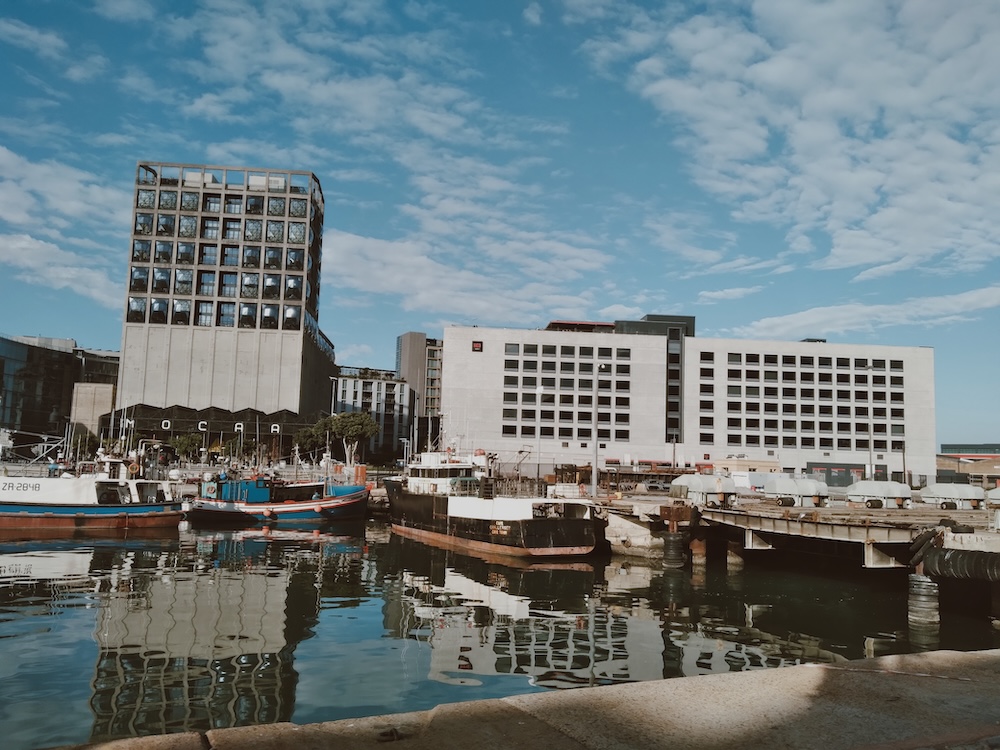
Cape Town’s Zeitz Museum of Contemporary Art Africa begins with a building that remembers labor. The grain silo at the V&A Waterfront was constructed in the early twentieth century to store and grade maize before export. Heatherwick Studio did not erase its forty-two concrete tubes. The architects carved through them, turning industrial repetition into a cathedral-like atrium.
Travel for art is most powerful when the place and the work refuse separation. At Zeitz MOCAA, you cannot move through galleries of contemporary art from Africa and its diaspora without feeling the continent’s histories of extraction, trade, infrastructure and transformation inside the architecture itself.
Enter through a grain of corn
The design team scanned a single kernel and enlarged its irregular form to create the atrium’s cutting geometry. Concrete tubes that once held grain were sliced open, polished and fitted with glass. Some became galleries. Others remain legible as cylinders, allowing the original purpose of the building to stay physically present.
This is not adaptive reuse as cosmetic charm. The intervention is violent and tender at once. Thousands of tons of concrete were removed, yet the scars are the design. Light drops through the roof and catches curved surfaces that were never intended to be seen from inside.
The silo rises at Cape Town’s waterfront, a location shaped by commerce and spectacular views. From the museum, Table Mountain appears as more than backdrop. It reorients every enclosed room toward a geography larger than the institution.
The scars are the design.
A museum with a continental responsibility
Zeitz MOCAA opened in 2017 as a not-for-profit institution dedicated to contemporary art from Africa and its diaspora. Its creation began with the Zeitz Foundation collection and a partnership with the V&A Waterfront. The ambition was enormous: build a museum capable of holding major work while confronting the fact that African modern and contemporary art had too often been collected and interpreted elsewhere.
No museum resolves that history by opening its doors. Questions of ownership, representation, funding and curatorial authority remain alive. That is exactly why the institution is worth visiting. A serious museum is not a vault of settled answers. It is a public structure where decisions can be seen and debated.
Check the current exhibition program before arriving; the work on view changes, and the museum’s value is not exhausted by the building. Give the galleries time before climbing toward the rooftop sculpture garden. Architecture photographs beautifully, but art needs the slower attention that travel schedules often steal.
How to make the visit count
Begin at the atrium and look upward, then walk to the edge where the original tube walls reveal their thickness. Notice how the same concrete can feel monumental in one space and intimate in another. The building teaches scale before the first label is read.
Move through the galleries without trying to convert an entire continent into one visual story. Africa is not a theme. The diaspora is not a style. Attend to the artist, city, material and date attached to each work. Difference is the point.
Leave space for the neighborhood as well. The V&A Waterfront can feel polished and touristic; Cape Town beyond it carries deep spatial inequalities created by colonialism and apartheid. An art journey that sees only the museum has not fully seen the place.
Zeitz MOCAA rewards this layered attention. A former machine for export now holds cultural production. Concrete once organized grain by volume; galleries now gather voices that cannot be measured into one category.
I recommend the museum because its contradictions remain visible. Beauty does not conceal the industrial past. Ambition does not eliminate institutional questions. The building keeps asking what can be transformed, what must be remembered, and who gets to shape the next use.
That is absolutely a journey deeply worth making.
Plan enough time to resist the checklist. Sit where the atrium’s carved void meets the old cylinder walls. Read the artists’ names aloud. Then step outside and look back at the silo from the waterfront. The building’s exterior still holds the disciplined vertical rhythm of storage; the interior has been opened into unpredictability.
That movement—from container to conversation—is the museum’s most compelling work, and Cape Town gives it urgency.