
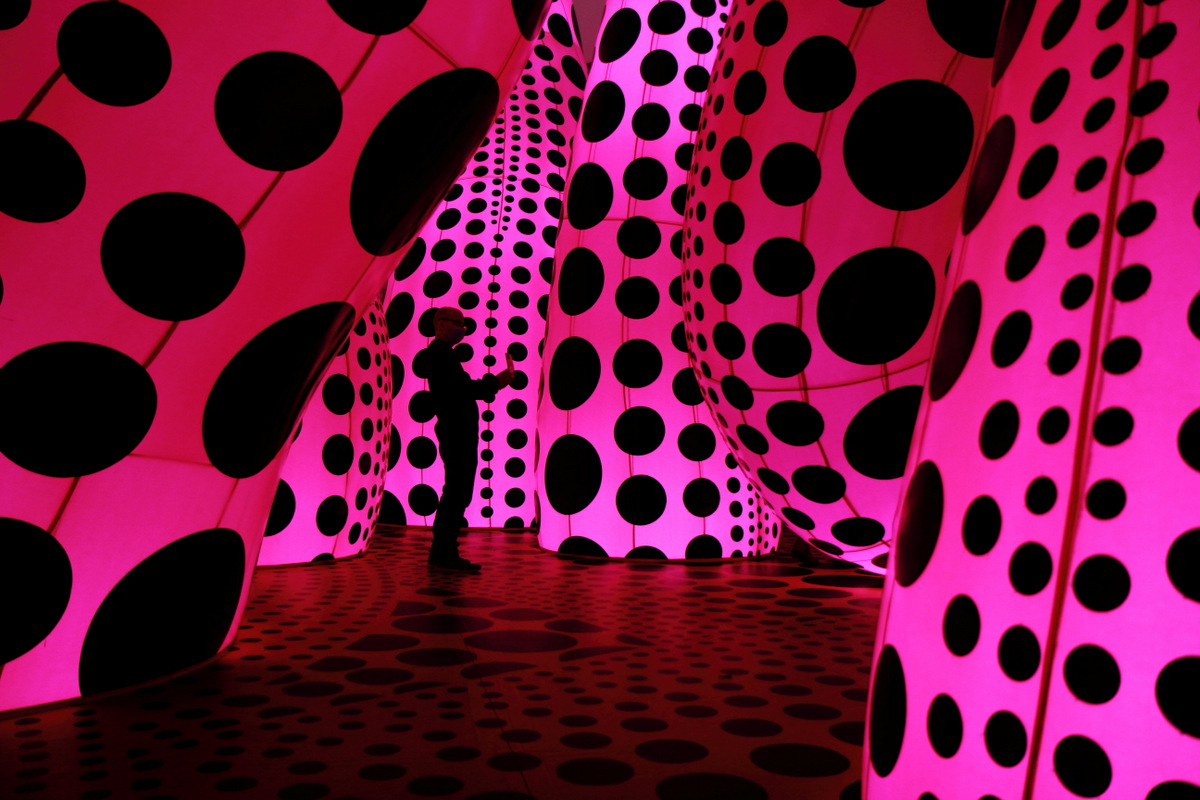

Yayoi Kusama, the Japanese artist who transformed repeated dots, mirrored rooms and visions of infinity into one of contemporary art’s most recognizable languages, has died at 97. Her studio announced on August 27 that she died in a Tokyo hospital on August 14. No cause was given.
The news closes an extraordinary life of sustained invention. Kusama worked across painting, sculpture, performance, installation, fiction and poetry, turning intensely personal experiences into environments shared by millions.
Repetition became a way to face infinity
Born in Matsumoto in 1929, Kusama began drawing as a child. She later described hallucinations in which patterns seemed to spread across rooms and over her own body. Rather than treating repetition as decoration, she made it a method: dots and nets multiplied until a single mark appeared to dissolve into a field.
After moving to New York in 1958, she entered an art world dominated by men and developed vast “Infinity Net” paintings through painstaking, all-over gestures. The scale and persistence of those works placed her in conversation with Abstract Expressionism and Minimalism while refusing to belong neatly to either.
Her happenings and body festivals in the 1960s brought painted bodies, fashion and political protest into public space. She also made soft sculptures covered in repeated phallic forms, combining humor, anxiety and obsessive accumulation.
Kusama made repetition feel at once intimate and cosmic: a mark could be a symptom, a shield, a universe and an invitation.
The mirrored room changed how audiences enter art
Kusama first used mirrors to multiply light and objects in the 1960s. Her later Infinity Mirror Rooms became global phenomena, surrounding visitors with reflected points of light and apparently endless space. Their popularity on social media sometimes threatened to reduce a complex practice to a spectacular backdrop, yet the rooms retain a philosophical force. The viewer sees the self repeated and diminished inside something immeasurable.
After returning to Japan in 1973, Kusama continued to work and write. She voluntarily lived in a psychiatric hospital from the late 1970s and maintained a studio nearby. The arrangement became part of public accounts of her life, but it should not overshadow the discipline of her practice or the strategic intelligence with which she rebuilt an international career.
Her representation of Japan at the 1993 Venice Biennale marked a major return to global attention. Museum surveys followed, while pumpkin sculptures and immersive rooms brought her work to audiences far beyond specialist art circles.
A global image never replaced the working artist
Kusama’s visual vocabulary became ubiquitous: polka dots covered paintings, rooms, fashion collaborations and monumental pumpkins. Recognition at that scale can flatten an artist into a brand. Her best work resists that flattening because repetition never settles into a single mood. It can be playful, claustrophobic, ecstatic or severe.
According to her studio, Kusama continued painting until her final days. That detail matters. Behind the queues, photographs and instantly recognizable surfaces was an artist returning to the canvas, repeating a gesture not because it was easy, but because repetition remained inexhaustible.
Her legacy is not simply that dots became famous. It is that she made private perception public without surrendering its strangeness. In rooms of mirrors and fields of paint, Kusama gave viewers a way to feel both vividly present and almost vanished—one body among countless points of light.
Continue reading: The Roman Space Telescope Is About to Open a Vast New Eye · Twenty-Six Louvre Masterpieces Are Crossing the Atlantic for the First Time