
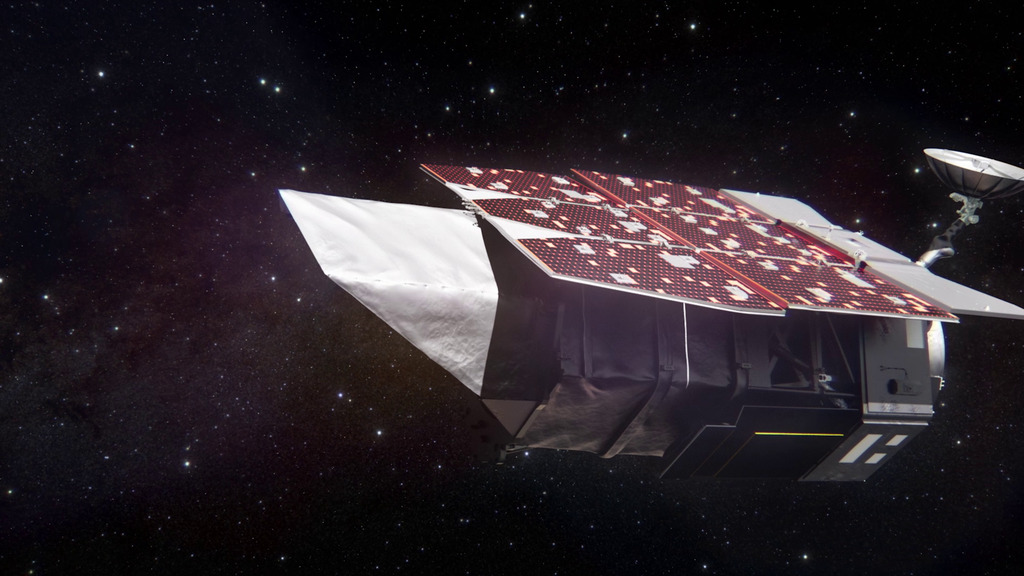

Artist’s concept of the Nancy Grace Roman Space Telescope. NASA Goddard Conceptual Image Lab / NASA editorial reuse.
Before a telescope can reveal the universe, human hands must build an object capable of surviving the journey. NASA’s Nancy Grace Roman Space Telescope came together from millions of individual components assembled by more than a thousand technicians and engineers. Now it is enclosed for launch, and the machine is about to become an eye.
NASA and SpaceX are targeting liftoff no earlier than 7:26 a.m. EDT on Sunday, August 30, 2026, from Launch Complex 39A at Kennedy Space Center. A Falcon Heavy will carry Roman away from Earth. Its destination is the second Sun–Earth Lagrange point, L2, roughly one million miles from us.
A wide field built for big questions
Roman’s primary mirror measures 2.4 meters, or 7.9 feet—the same diameter as Hubble’s. The similarity ends when we consider how each observatory frames the sky. Roman’s 300-megapixel Wide Field Instrument can capture an area at least 100 times larger than Hubble’s while maintaining comparable sharpness and sensitivity. One Roman image can hold the equivalent detail of one hundred Hubble pictures.
That is not merely a technical improvement. It changes the kind of questions scientists can ask. Roman is designed to map billions of galaxies, investigate dark energy and dark matter, study black holes and discover and characterize exoplanets. Its second instrument, a coronagraph technology demonstration, will test methods for seeing faint planets beside the overwhelming light of their stars.
I think of every telescope as an act of imaginative discipline. The engineers must design for phenomena they cannot touch. They shape mirrors, detectors, shields and software so light that has traveled through deep time can arrive as evidence.
Roman is not being sent into space to confirm how much we already know.
The invisible labor inside the image
Pictures from space can feel effortless once they reach our screens. They are anything but. Roman’s barrel-like form helps block unwanted light from the Sun, Earth and Moon, while its distant orbit helps keep the instruments cool. Three carefully adjusted mirrors focus incoming light onto a ring rather than a single central point. The Wide Field Instrument’s eighteen detectors are arranged in an arch along that ring, allowing the observatory to produce broad images with consistent sharpness.
Every one of those decisions is the residue of testing, correction and patience. Before shipment to Florida, the completed observatory underwent environmental trials intended to imitate the vibration and acoustic force of launch. It arrived at Kennedy Space Center on June 21. By August 24, NASA reported it encapsulated inside the rocket’s payload fairing.
The story is extraordinary because the final object has to disappear into its purpose. No one builds Roman so we can admire its engineering in a clean room forever. The telescope succeeds when the fairing opens, the spacecraft travels to L2, the instruments commission correctly and the first surveys begin to return.
A new scale of seeing
Roman carries the name of Nancy Grace Roman, NASA’s first chief astronomer and a foundational advocate for space-based astronomy. That lineage matters. Scientific instruments do not emerge from one heroic moment; they grow through generations of people who make the next view possible.
The primary mission is planned for five years, with a goal of operating for ten. After processing, its science data will be publicly available. This generosity may prove as consequential as the hardware. Researchers around the world will be able to work with an unprecedented survey of the infrared universe, finding patterns the original teams did not anticipate.
Artists understand that a new tool does not simply make old work faster. It changes perception. The camera altered painting. Film changed time. Digital imaging changed scale and circulation. Roman’s immense field of view will do something similar for astronomy: it will replace isolated glimpses with connected territories.
Roman’s planned surveys also depend on speed. Its detectors will cover enormous regions repeatedly, making it possible to notice change: stars brightening, supernovae appearing, and distant worlds briefly revealing themselves through gravitational microlensing. A wide view is not only a bigger picture. Repeated over time, it becomes a record of cosmic movement.
There is poetry in the mission’s public archive, but also accountability. The light belongs to no institution. NASA’s commitment to release processed data means the instrument can become a shared studio for discovery, open to questions that have not yet been formulated.
On launch morning, fire and machinery will command the attention. But the deeper event will unfold quietly afterward, one signal at a time. A human-built eye will open far from Earth, and the universe will become larger because we have learned how to see more of it at once.
Continue reading: Pope Leo XIV Draws a Line Between Human Art and AI · RM Opens His Private Art Collection to the Public at SFMOMA