

The Louvre Islamic art exhibition arriving in Washington this September will move twenty-six masterpieces across the Atlantic for the first time. From the Louvre: Masterpieces of Islamic Art opened at the Smithsonian’s National Museum of Asian Art on September 26, bringing together objects made from the seventh through the nineteenth centuries across a geography extending from Spain to India.
The number is modest enough to encourage attention rather than accumulation. Each object can be encountered as a concentrated world of material, technique and movement. Among the announced highlights are an Andalusian bronze lion, a jewel-covered portrait of a Persian ruler and the celebrated Syrian-Egyptian basin known as the Baptistery of Saint Louis.
A basin that refuses a single identity
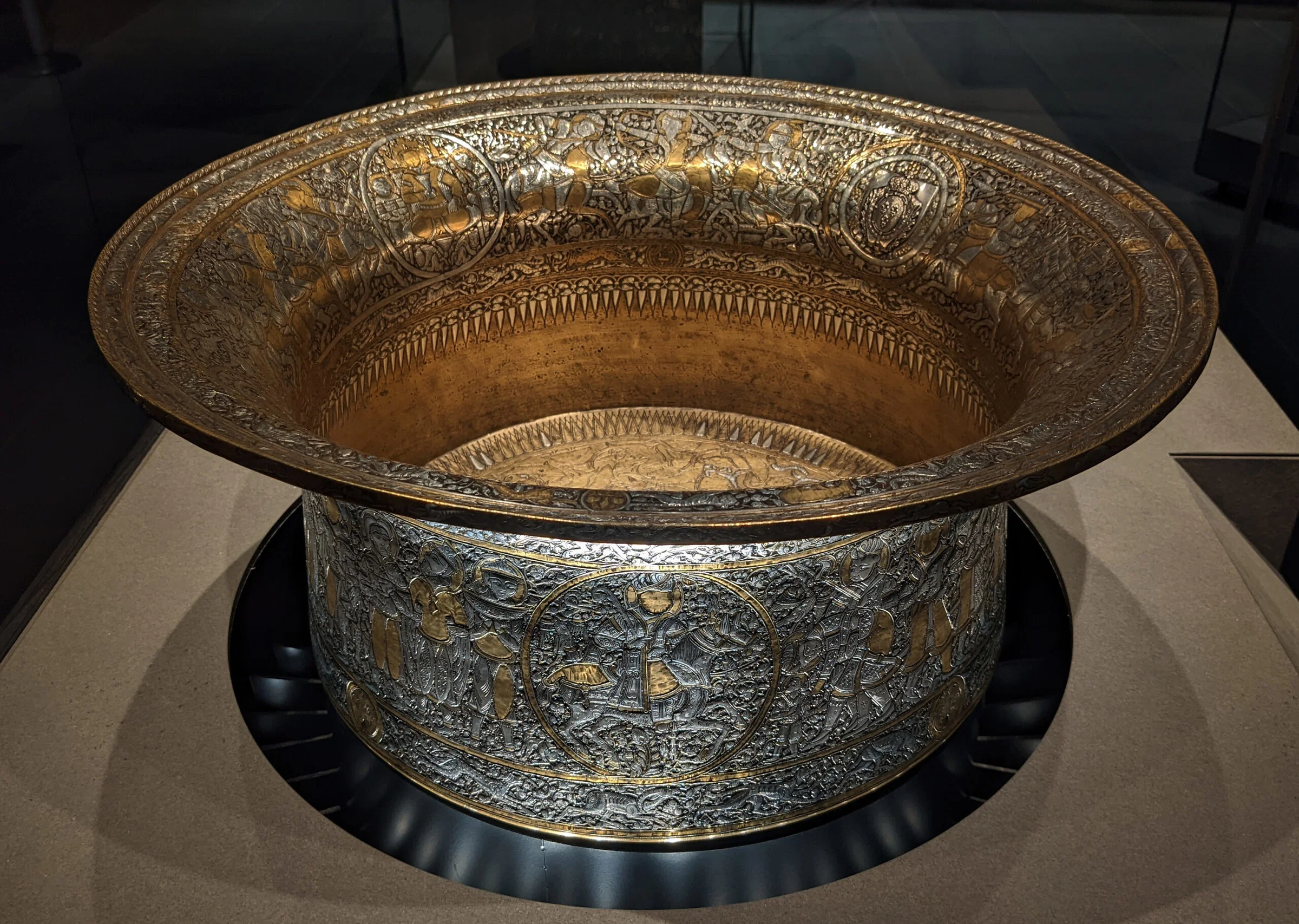
Signed by the metalworker Muhammad ibn al-Zayn and dated to around 1330–1340, the Baptistery of Saint Louis is made from copper alloy engraved and inlaid with gold, silver and black compound. Its surface is crowded with figures, animals, bands and coats of arms. The eye cannot take it in at once. It travels around the vessel, following scenes that unfold through metal rather than paint.
The name by which the object is widely known belongs to a later history. It was associated with royal baptisms in France, although it was created in the Mamluk world, probably in Syria or Egypt. That shift in context is not a footnote. It is part of the object’s meaning, revealing how artworks acquire new identities as they move through courts, rituals, collections and museums.
The art of inlay and attention
Metalwork can appear austere from a distance, but this basin rewards proximity. Fine engraved lines organize the surface while contrasting materials create flashes of brightness. Silver figures emerge against warmer copper alloy; gold punctuates the design; black inlay deepens the drawing. The technique transforms a functional form into a densely layered visual field.
That material intelligence is one reason the exhibition matters. Islamic art has too often been presented through broad labels that flatten enormous differences in time and place. Twenty-six carefully chosen works can instead make specificity visible: who made an object, what skills it required, where it traveled and how its use changed.
Objects as cultural ambassadors
The Smithsonian describes the exhibition as the first occasion on which this selection has crossed the Atlantic. Its curatorial argument follows the journeys of the works from their places of origin into the Louvre. Many were exchanged to secure alliances or reinforce power before passing among rulers, artists, archaeologists and collectors.
In Washington, those histories will take on another layer. A museum loan is itself a contemporary form of diplomacy. Packing, conservation, insurance and institutional trust are invisible parts of the exhibition, but they determine whether an object can travel. The display therefore presents both historic exchange and a modern agreement about shared cultural access.
Why a focused exhibition can feel enormous
The show occupies Galleries 23 and 24 in the museum’s East Building and remains on view through January 18, 2027. It is organized jointly by the Louvre and the National Museum of Asian Art, with curators Souraya Noujaim and Simon Rettig. The scale should allow visitors to slow down, circle objects and recognize details that vanish in a crowded survey.
The most powerful idea may be movement itself. These works did not remain still even before the exhibition began. They crossed languages, empires and systems of value. Their materials carry one history; their names sometimes carry another; their museum labels carry the latest interpretation. When they arrive in Washington, they will not simply represent the Louvre. They will reveal how art survives by accumulating journeys.
Sources
Smithsonian National Museum of Asian Art
Continue reading: RM Opens His Private Art Collection to the Public at SFMOMA · Los Angeles Opens a Museum Shaped Like a Story