
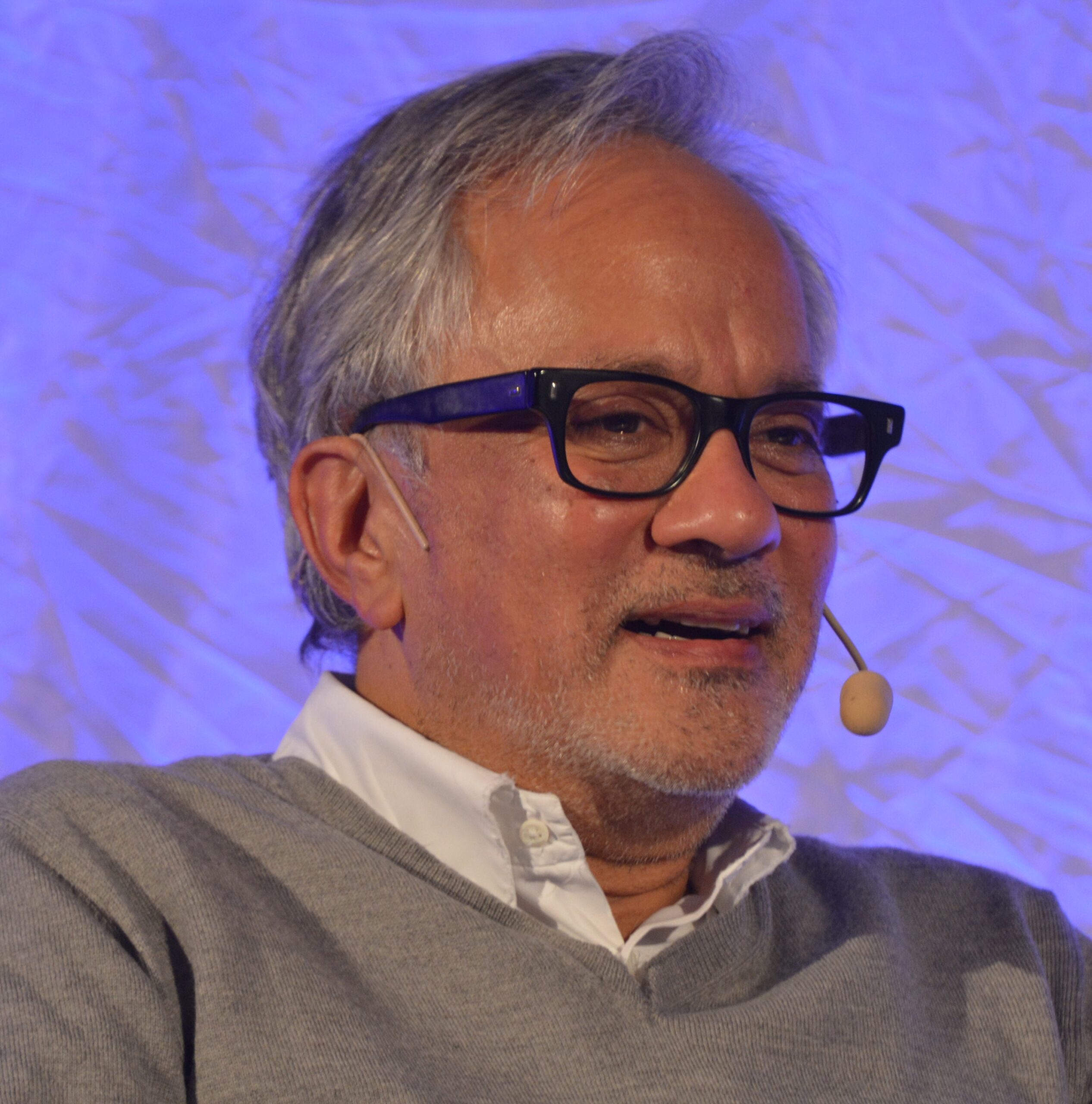
Anish Kapoor, photographed in 2017. Bengt Oberger / CC BY-SA 4.0.
Anish Kapoor has spent decades giving emptiness a surface. At the Hayward Gallery in London, that pursuit becomes physical: pigment appears bottomless, polished forms disturb the room, and openings refuse to tell the eye where they end.
Anish Kapoor is open from June 16 through October 18, 2026, at the Southbank Centre’s Hayward Gallery. It is the artist’s first major London survey in more than fifteen years, bringing together early pigment works, monumental sculpture and installations that turn looking into a bodily risk.
Color with its own gravity
Kapoor does not place color on an object. He makes color behave like an object.
That difference is central to the exhibition. In the early works, loose pigment blurs the edge between sculpture and surrounding air. Red, blue, yellow and black appear to rise from the floor or withdraw into themselves. The material looks both ancient and impossible: powder without a fixed skin, geometry softened by intensity.
I know how easily color can become decoration when it is asked to make a surface more attractive. Kapoor asks much more of it. His saturated hues establish distance, temperature and psychological pressure. Red can feel internal, as if the gallery has exposed something beneath its architecture. Black can cancel the information the eye expects and make depth uncertain.
This is why the Hayward is such a potent setting. Its concrete rooms have weight and edges. Kapoor’s forms do not politely occupy them; they alter the measure of the space. The building becomes a partner with resistance.
The void is not empty
Kapoor’s voids are famous because they expose a primitive conflict in perception. We want to understand whether we are seeing a hole, a painted surface or an object. The eye searches for scale and boundary, while the body registers caution. Knowledge arrives too slowly to reassure us.
That delay is the work. A dark cavity can look flat until movement reveals its depth. A mirror can return the room upside down or stretched beyond recognition. The familiar laws of reflection remain in force, yet the result feels unstable. Kapoor makes certainty fail without resorting to narrative.
The exhibition spans more than four decades, so visitors can follow this problem across materials and scales. Pigment gives way to wax, stone, steel and engineered surfaces. The vocabulary expands, but the question remains severe: when does matter begin to feel immaterial, and when does absence acquire weight?
A survey that moves through the body
A career survey can become a timeline pinned to walls. Kapoor’s work resists that treatment because it requires position. Stand here and the surface opens; take two steps and it closes. Approach a polished sculpture and your own image enters the piece. Retreat and the room returns.
This choreography makes the visitor responsible. You cannot consume these works from one neutral viewpoint. Your height, distance and movement change what appears. Even photographs struggle to communicate the experience because a camera freezes the very instability Kapoor has constructed.
His monumental public sculptures have made reflection part of civic life, but the Hayward offers a more concentrated encounter. Indoors, the optical seduction sits beside unease. Beauty becomes dangerous because it pulls the body closer to something the mind has not resolved.
That is what I recommend carrying into this exhibition: do not rush to name what you see. Notice the instant before recognition settles. Notice when color seems to detach from material, when a wall appears punctured, when your reflection no longer obeys you. Kapoor has built an art from those fractures.
Kapoor was born in Mumbai in 1954 and has lived and worked in London since the 1970s. That long relationship with the city gives this return particular force. London has encountered his work at intimate and monumental scales, from galleries to the vast red membrane of Marsyas in Tate Modern’s Turbine Hall in 2002. The Hayward survey gathers those decades without pretending that scale alone is the achievement.
What holds the career together is a decision to make materials contradict their ordinary behavior. Stone seems weightless. Steel bends the horizon. Wax becomes a wound that can move. Powder acquires architecture. These are not tricks added after the fact; each contradiction begins in the physical property of the chosen substance.
The exhibition remains open until October 18. Go while the void is still holding the room.
Continue reading: Pope Leo XIV Draws a Line Between Human Art and AI · RM Opens His Private Art Collection to the Public at SFMOMA