
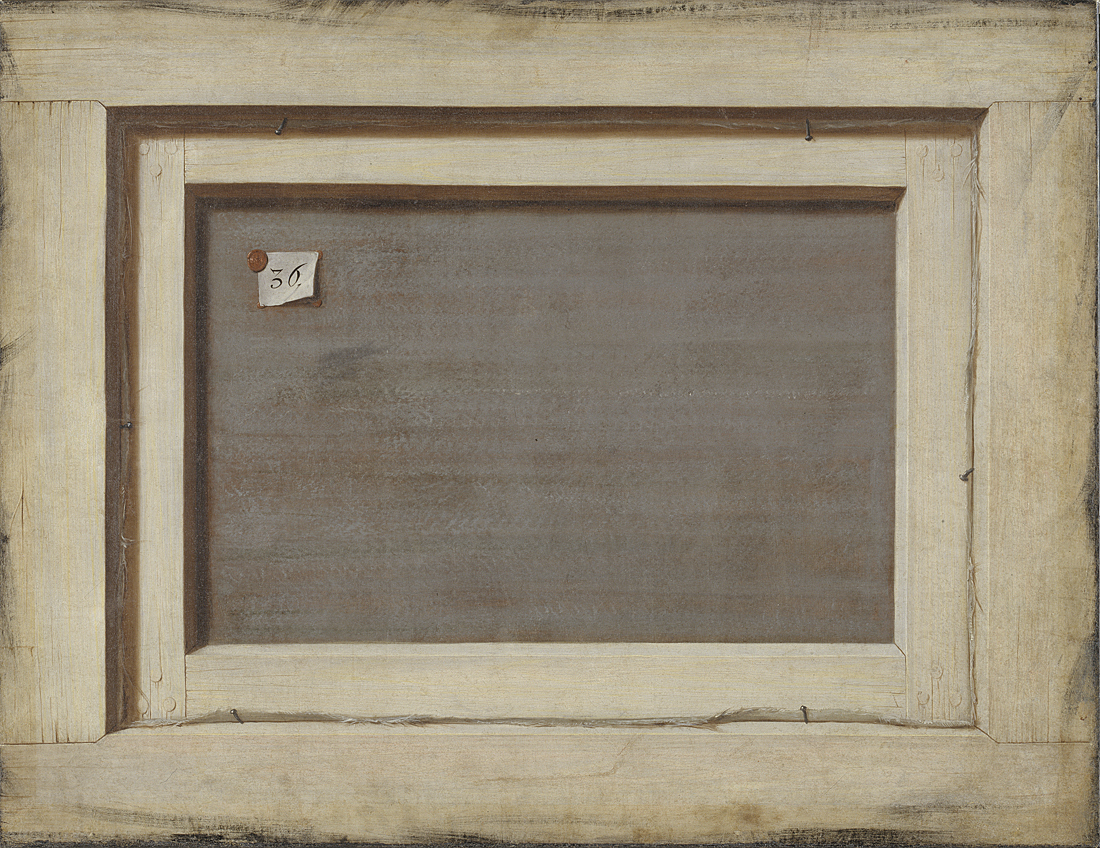

Cornelius Norbertus Gijsbrechts, The Reverse of a Framed Painting, 1668-1672. SMK; Statens Museum for Kunst / CC0 1.0.
Before an artwork leaves the studio, write down what it looks like. Before it enters a gallery, do it again. Repeat the process after unpacking and before the return journey.
This habit can prevent arguments, guide conservation and show whether a change occurred during handling, transport or display. The report does not need grand language. It needs precise observation, photographs and signatures.
Identify the exact object
Begin with the artist, title, date, medium, dimensions and an identifying number. Record whether dimensions include the frame, base or mount. Add the owner, current location, examiner, date, reason for examination and the next destination. For an edition, include the edition number. For components, list how many pieces belong to the work.
Photograph the entire front under even light, then the back, sides, frame, base, labels and signatures. Include a color target and ruler in reference views. The Smithsonian Museum Conservation Institute recommends a dated scale card and a written description of fiber, weave, surface, seams, additions, design, inscriptions and damage when documenting textiles. The same principle applies across media: name what is physically present.
Use a diagram or annotated photograph to locate each observation. “Scratch on painting” is weak. “Three-centimeter diagonal surface abrasion, upper right quadrant, beginning 6.5 centimeters from the top edge” can be found again.
A condition report is not an accusation waiting to happen. It is a shared memory made before people disagree.
Describe, do not diagnose
Write what you can see: crack, loss, dent, stain, tear, lifting edge, loose join, discoloration, accretion, distortion or abrasion. Avoid guessing at cause unless a qualified conservator has examined it. “Brown stain caused by water” is an interpretation; “irregular brown tide line measuring twelve centimeters” is an observation.
Distinguish between the artwork’s intentional character and later change. Rough edges, drips, exposed staples or uneven surfaces may belong to the artist’s method. The artist should document these features when the work is new so someone does not later mistake them for damage.
Check the support and display system as carefully as the visible face. For paintings, inspect stretcher, keys, hanging hardware, glazing, backing board and frame corners. For sculpture, examine joins, base, fasteners and contact points. For works on paper, look for planar distortion, tears, hinges, mat burn and contact with glazing. For media art, record hardware, cables, software version and successful playback.
Use the report at every handoff
Complete the outgoing report before packing. The artist or lender and the person accepting custody should review it together whenever possible. Both sign and date it. Place a copy with the loan file, not loose against the artwork inside the crate.
On arrival, unpack in a clean, well-lit area and compare the object with the outgoing record. Do not copy the old description without looking. Mark “no change” only after checking every recorded area. Photograph any new observation before installation and notify the responsible parties immediately.
Repeat the comparison when the exhibition closes. If a courier accompanies a high-value or fragile work, the courier should witness examination, installation and repacking. The report becomes a sequence, showing condition across time rather than a single frozen statement.
Keep the photographs in their original resolution and preserve metadata. Name them with the object number, date and view. Do not rely on images embedded in a low-resolution document as the only record. Store the signed report, image files, loan agreement, packing instructions and correspondence together.
If you find active flaking, structural instability, mold, fresh staining, pest activity or a dangerous loose component, stop handling and contact a qualified conservator. A condition report records a problem; it does not authorize an untrained repair.
A useful report also records the packing method. Note which surface faces upward, the order of wrapping layers, location of foam blocks, hardware removed for transit and orientation inside the crate. Photograph the object before wrapping, at key packing stages and inside the open crate. Those images help the receiving team reverse the process without improvisation.
For a new artwork, the artist can create a baseline report as part of completion. Include approved installation drawings, lifting points, weight, electrical requirements and surfaces that must never be touched. If a deliberate crack, patina or irregular seam belongs to the work, state that clearly and photograph it. Future handlers should not have to guess where intention ends and deterioration begins.
The practice may feel slow the first time. Soon it becomes part of making, lending and collecting responsibly. Five careful minutes before movement can preserve facts that no amount of memory can recover later.
Continue reading: Pope Leo XIV Draws a Line Between Human Art and AI · RM Opens His Private Art Collection to the Public at SFMOMA