
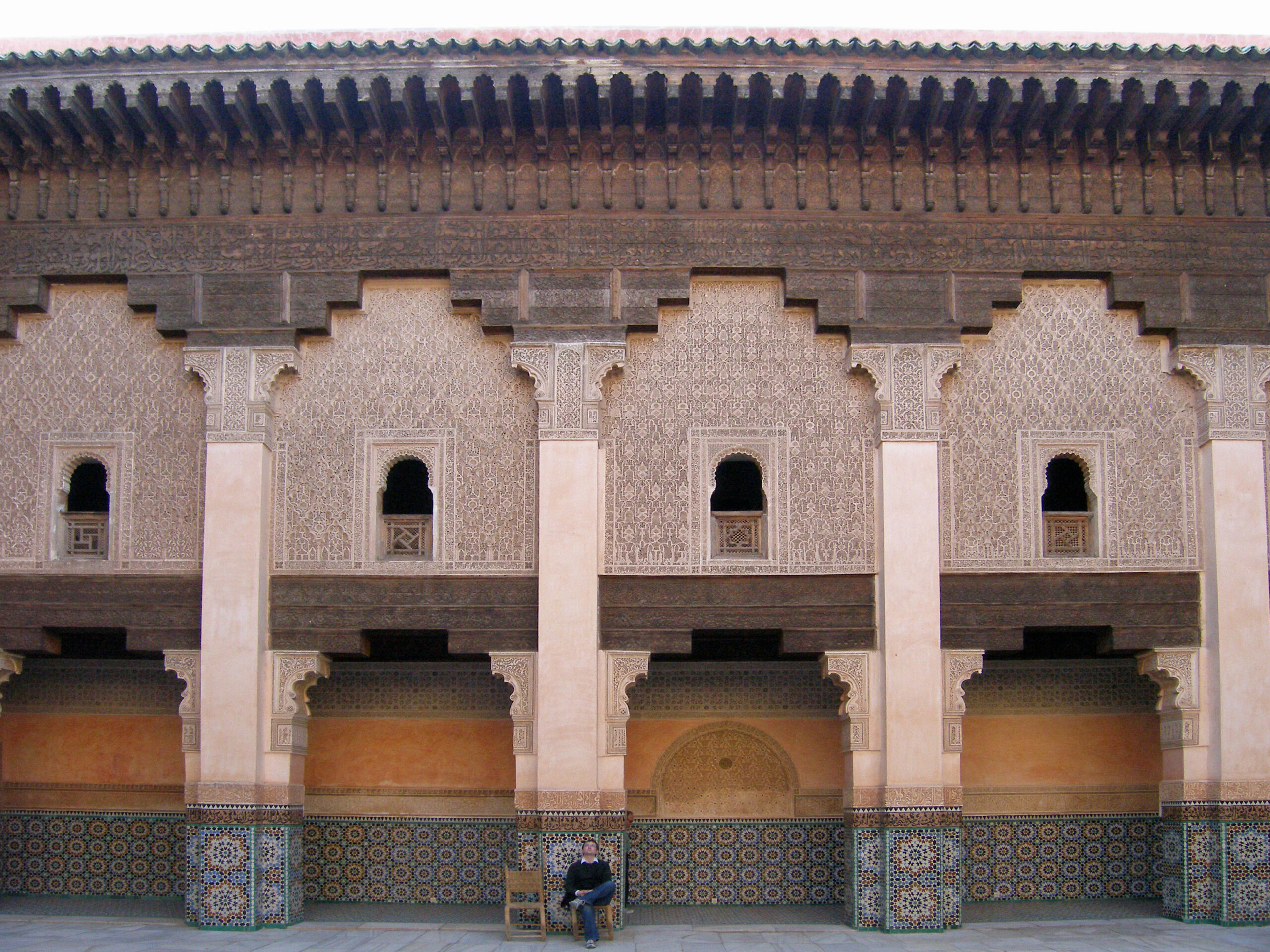

The courtyard of Ben Youssef Madrasa, Marrakech. China Crisis / CC BY-SA 2.5.
Marrakech is often reduced to one irresistible photograph: a wall of saturated Majorelle blue against cactus green. That image deserves to be seen, but an art journey through the city becomes much richer when the garden is treated as a beginning rather than the conclusion.
Across Marrakech, designed landscape, Amazigh material culture, fashion, architecture and contemporary African art create a route that cannot be contained by one museum. I recommend dividing it across two days, allowing the medina’s workshops and buildings to remain part of the experience instead of becoming scenery between tickets.
Begin where color became architecture
French painter Jacques Majorelle began creating his garden after settling in Marrakech. Its electric blue studio and carefully assembled plants turned color into inhabitable space. The site later became closely associated with Yves Saint Laurent and Pierre Bergé, whose stewardship helped preserve it.
The official Jardin Majorelle site currently lists daily hours from 8:30 a.m. to 6 p.m., with last entry at 5:30. Tickets must be purchased online through the official platform. Arrive early: quieter paths make it easier to notice how painted walls, water, shadow and botanical form build the composition.
Within the site, the Pierre Bergé Museum of Berber Arts presents jewelry, textiles, clothing and domestic objects as works of knowledge rather than decorative inspiration. The museum is currently open daily from 9 a.m. to 5:30 p.m. Its presence matters because the visual culture that fascinated visiting designers has deep local authorship, techniques and meanings.
Follow fashion back to drawing
Nearby, the Musée Yves Saint Laurent Marrakech focuses on the designer’s work and the city that nourished his palette and imagination. The museum is closed Wednesday, so coordinate it with the garden rather than assuming identical schedules.
Look beyond finished garments. Fashion begins in lines, swatches, fittings, revisions and collaborations. The museum’s architecture and displays make it possible to read couture as a total art involving drawing, textile, movement, performance and graphic identity.
The city’s strongest art route moves between living craft, designed landscape and contemporary argument.
That means resisting the habit of calling every traditional object “inspiration” for a European designer. Spend time with the Berber Arts museum on its own terms. In the medina, observe what is being made now—woodwork, metal, leather, weaving and plaster—without treating workshops as an open studio unless the maker invites conversation or photography.
End with contemporary Africa
MACAAL, the Museum of African Contemporary Art Al Maaden, expands the route beyond the historic center. The independent nonprofit museum presents modern and contemporary practice from Morocco and across the African continent through temporary exhibitions and installations.
Its distance from the medina is useful. The change of neighborhood interrupts the romantic image many visitors carry and asks how artists address the present: urbanization, ecology, migration, gender, memory, technology and the politics of representation. Check the museum’s live site for current exhibitions and hours before arranging transportation.
Give Marrakech two different tempos. On the first day, pair Jardin Majorelle with the two adjacent museums and leave space to sit with the colors rather than collecting photographs. On the second, visit MACAAL and then return to the medina for architecture and craft with a more attentive eye.
Practical care improves the art experience. Buy official tickets only, ask before photographing people or workspaces, and confirm whether temporary exhibitions permit photography. Use a registered guide if you want specialist access or historical depth, but be clear that your interest is art, design and making rather than shopping commissions.
Build in time for architecture without turning homes, mosques or courtyards into consumable backdrops. Access rules vary, and many sacred or private spaces are not open to nonresidents. The respectful traveler reads signs, dresses with the setting in mind and values what cannot be photographed as much as what can.
Late afternoon can be reserved for sketching or notes rather than another attraction. Write down combinations of color and material while they are fresh: carved plaster beside cedar, woven geometry beside tile, shadow crossing earth-colored wall. Reflection keeps the journey from becoming a blur of beautiful surfaces.
Marrakech will give you color immediately. Its deeper gift takes longer: the understanding that color belongs to material, climate, ritual, labor and history. Follow the blue, certainly. Then keep looking until the city becomes more complex than the image that brought you there.
Continue reading: Pope Leo XIV Draws a Line Between Human Art and AI · RM Opens His Private Art Collection to the Public at SFMOMA