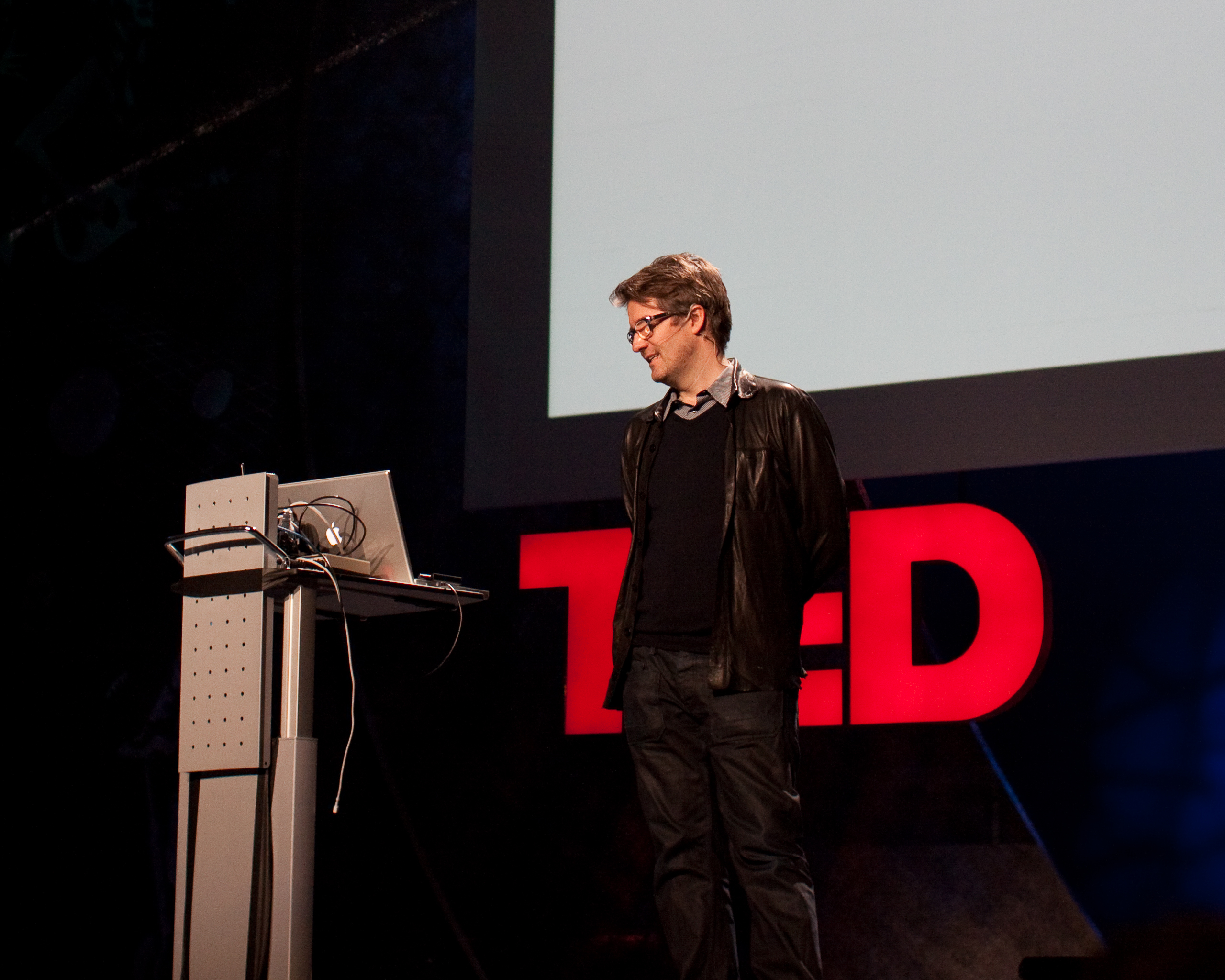

Olafur Eliasson speaking at TED, February 5, 2009. Bill Holsinger-Robinson / CC BY 2.0.
Olafur Eliasson makes art from conditions we often stop noticing: light entering a room, water changing direction, color lingering in the eye, a reflection reorganizing space. His public statements return again and again to one idea—the viewer is not outside the experience.
That position becomes ecological as well as perceptual. If there is no outside, nature is not scenery beyond a window and climate is not an abstract crisis happening elsewhere. We are inside the systems we observe.
Life is space
For his 2021 project Life at Fondation Beyeler, Eliasson removed the museum’s glass façade and allowed the surrounding pond to enter the building. The water was dyed green with a safe tracer, and the installation remained open day and night. Boundaries between exhibition room, garden, weather and living organisms became porous.
In his artist statement, Eliasson wrote that “life is space.” He described space not as an empty container but as movement, time, relationships and coexistence. Visitors did not stand before a discrete object. They entered a changing situation shaped by daylight, temperature, plants, insects and water.
The project’s phrase “there is no outside” rejects a comforting separation. A museum cannot seal itself away from ecology, and a human body cannot become an independent spectator of the planet.
For Eliasson, perception is participation: the viewer helps make the work by moving through it.
Your body is a measuring instrument
Eliasson’s installations often reveal the mechanics of their effects. Lamps, mirrors, mist nozzles and scaffolding may remain visible. The experience can be astonishing without pretending to be supernatural. We are invited to notice both the phenomenon and the apparatus producing it.
That transparency changes our role. In a room filled with colored light, the eye adapts; when ordinary illumination returns, an afterimage appears. The artwork continues inside the viewer’s visual system. Walk around a mirror and the reflected architecture moves because you moved.
His famous The weather project at Tate Modern in 2003 used a semicircle of lamps, mirror foil and artificial mist to create an immense indoor sun. Visitors lay on the Turbine Hall floor and watched their small reflections gather overhead. The technology was exposed, yet the communal emotion remained real.
Eliasson’s writing calls this capacity “seeing yourself sensing.” Attention turns back toward the process by which an experience is formed. We recognize that perception is never passive reception; it is produced through body, memory, expectation and position.
Climate must become felt
That understanding supports his climate work. In Ice Watch, blocks of glacial ice harvested from a Greenland fjord were placed in public squares in Copenhagen, Paris and London. People could touch them and hear ancient air escaping as they melted. A planetary measurement became immediate duration.
For a 2022 TIME cover, Eliasson created an afterimage of Earth and accompanied it with a short poem instructing readers to look down and recognize the planet beneath them. The image insisted that everyone’s relationship with Earth is singular while the home is shared.
He does not claim that an artwork replaces policy or scientific evidence. Its power lies elsewhere: art can change the felt scale of information. Tons of ice loss become cold water under a hand. Atmospheric change becomes color altered in the eye.
I admire the responsibility embedded in that move. Eliasson does not present nature as pure and distant, waiting to be saved by heroic viewers. He places us inside consequence. The work asks what we are already doing with our presence.
His statements join perception and ethics without turning either into a slogan. If every space is relational, then no action remains isolated. Light reaches a surface. Water carries heat. A body changes a room. A decision enters a system.
The studio follows this relational approach as well. Eliasson works with architects, engineers, craftspeople, researchers, cooks and administrators in Berlin. The collaborative structure is not separate from the art’s argument. A phenomenon that depends on several systems is produced by several kinds of knowledge.
His projects also return agency to the visitor. A rainbow appears only when light, mist and viewing angle align. A mirrored tunnel changes with every step. A colored shadow exists because a particular body interrupts several lights. The artwork is carefully constructed, but its final image cannot be completed in advance.
That uncertainty is generous. We are not asked to admire a solved object from the correct position. We discover that our position has consequences, then watch other people produce different versions of the same space.
There is no outside—and therefore no place from which to remain innocent.
Continue reading: Pope Leo XIV Draws a Line Between Human Art and AI · RM Opens His Private Art Collection to the Public at SFMOMA