
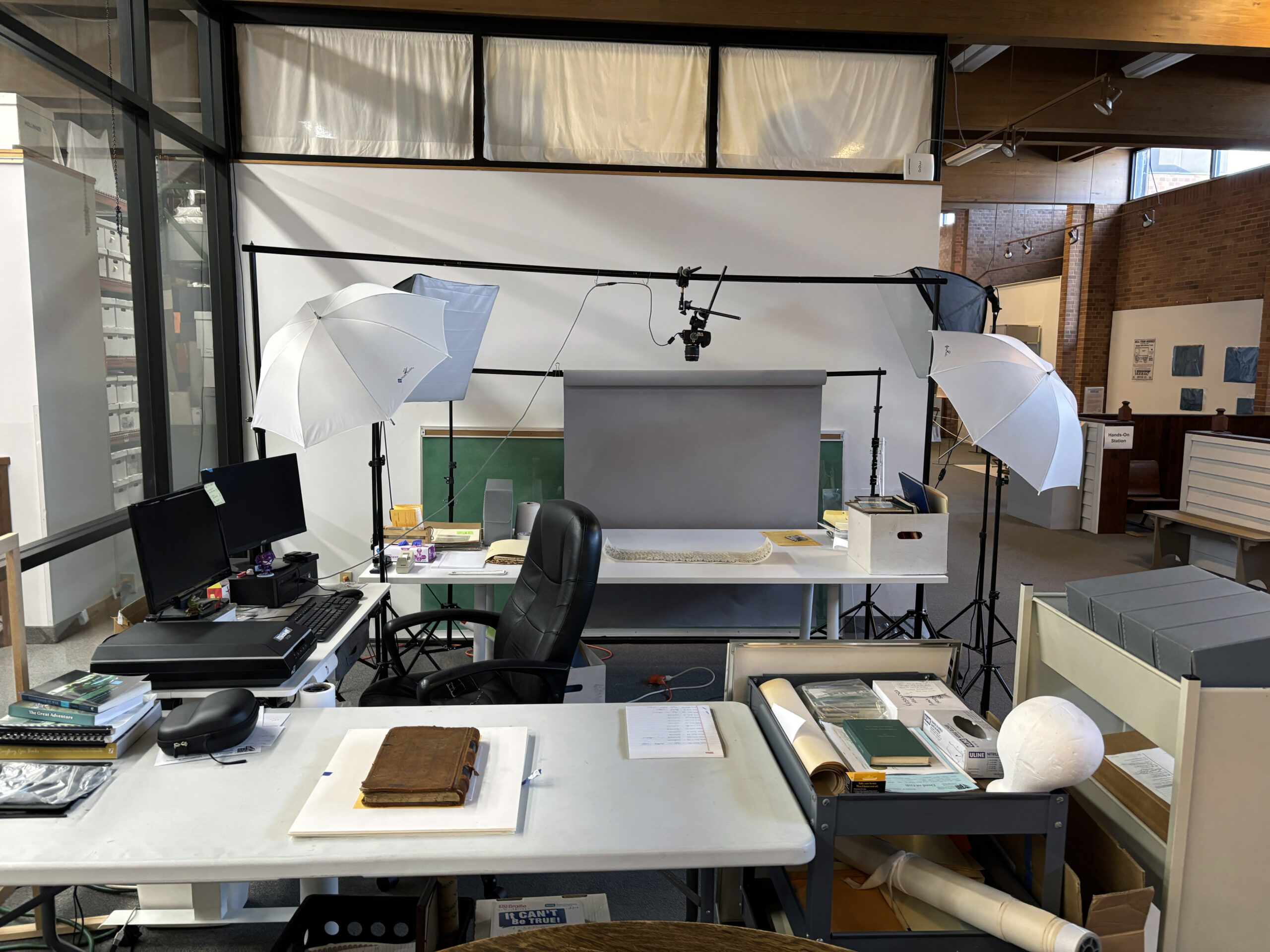

A museum photography setup with lighting and an overhead camera. Myotus / CC BY 4.0.
A work of art can leave your studio while its photograph stays with you for decades. That image may become the record used by a curator, collector, publisher, insurer or conservator. Treating documentation as an afterthought is one of the most expensive mistakes an artist can make.
You do not need a grand production for every piece. You need a repeatable process that gives you straight edges, even light, accurate color, usable scale and files you can find again.
Prepare the work and the room
Begin with the artwork, not the camera. Remove dust carefully. Check the frame and glazing. Decide whether the work should be photographed framed or unframed, and record both if the frame is integral. Never flatten, unmount or manipulate a fragile object simply to obtain a cleaner picture.
Place a two-dimensional work on a vertical wall whenever possible. The center of the artwork and the center of the lens should meet at the same height. Keep the camera sensor parallel to the picture plane; if the top edge looks narrower than the bottom, the camera is tilted.
Use a tripod or stable support in your own studio. Turn off mixed household lighting. Two matching lights placed at roughly forty-five degrees to the surface, one on each side, often give an even result. Move them until glare disappears and both halves receive equal illumination. For reflective varnish, glass, metallic leaf or deep texture, polarization or a professional photographer may be worth the cost.
The goal is not to make the photograph more dramatic than the artwork. The goal is to make it faithful.
Set exposure and color deliberately
Shoot the largest file your camera can produce. RAW files preserve more information for color correction; save a high-quality TIFF or JPEG derivative for ordinary use. Keep the ISO low to reduce noise, choose an aperture that holds the whole surface sharp, and use a timer or remote release so touching the camera does not introduce movement.
Include a neutral gray card, color target and scale in one reference frame. The Smithsonian Museum Conservation Institute advises making a scale card with the maker’s name, current date and an accurately measured line when documenting textiles for insurance, appraisal or conservation. That reference frame does not have to become the public image. It gives you evidence for color, date and size.
Then photograph a clean frame without the target. Do not stretch the proportions to make the work fill a standard rectangle. Crop square to the actual edges and leave enough resolution for print. Smithsonian’s contest guidance asks for web submissions at least 2,000 pixels wide and retains a 3,000-pixel longest-side expectation for high-resolution finalists; for an artist archive, keep the original camera file as well.
Make more than one useful view
One straight-on image is not enough for many works. Add a view of the back showing labels, signatures and construction. Photograph the signature separately. For sculpture, record front, back, both sides and a three-quarter view, keeping camera height consistent. Add details that show surface, joints, inscriptions or intentionally irregular passages.
If the work is installed, make an environmental photograph that shows scale and relationship to the room. Keep a separate object record with title, year, materials, dimensions, edition number if applicable, and the image filenames. Do not rely on the filename to carry all metadata.
Name files consistently. A useful structure might combine the artist surname, short title, year and view: Puello_BlueGarden_2026_front.tif. Avoid “IMG_4387-final-new.” Store one master set on your working drive, one backup on a separate device and one in a secure off-site or cloud location.
Color correction should restore accuracy, not reinvent the work. Adjust white balance and exposure using the reference target, remove dust spots caused by the camera sensor, and correct lens distortion if needed. Do not intensify saturation because the screen feels dull. View the artwork beside a calibrated monitor when possible.
Finally, export for purpose. A gallery may request a large JPEG in sRGB; a printer may need TIFF and a particular color profile; a website needs a smaller derivative. Never overwrite the master to satisfy one delivery specification.
The photograph becomes part of the artwork’s professional life. Make it carefully enough that years from now, when the piece is elsewhere, the record still tells the truth.
Continue reading: Pope Leo XIV Draws a Line Between Human Art and AI · RM Opens His Private Art Collection to the Public at SFMOMA