
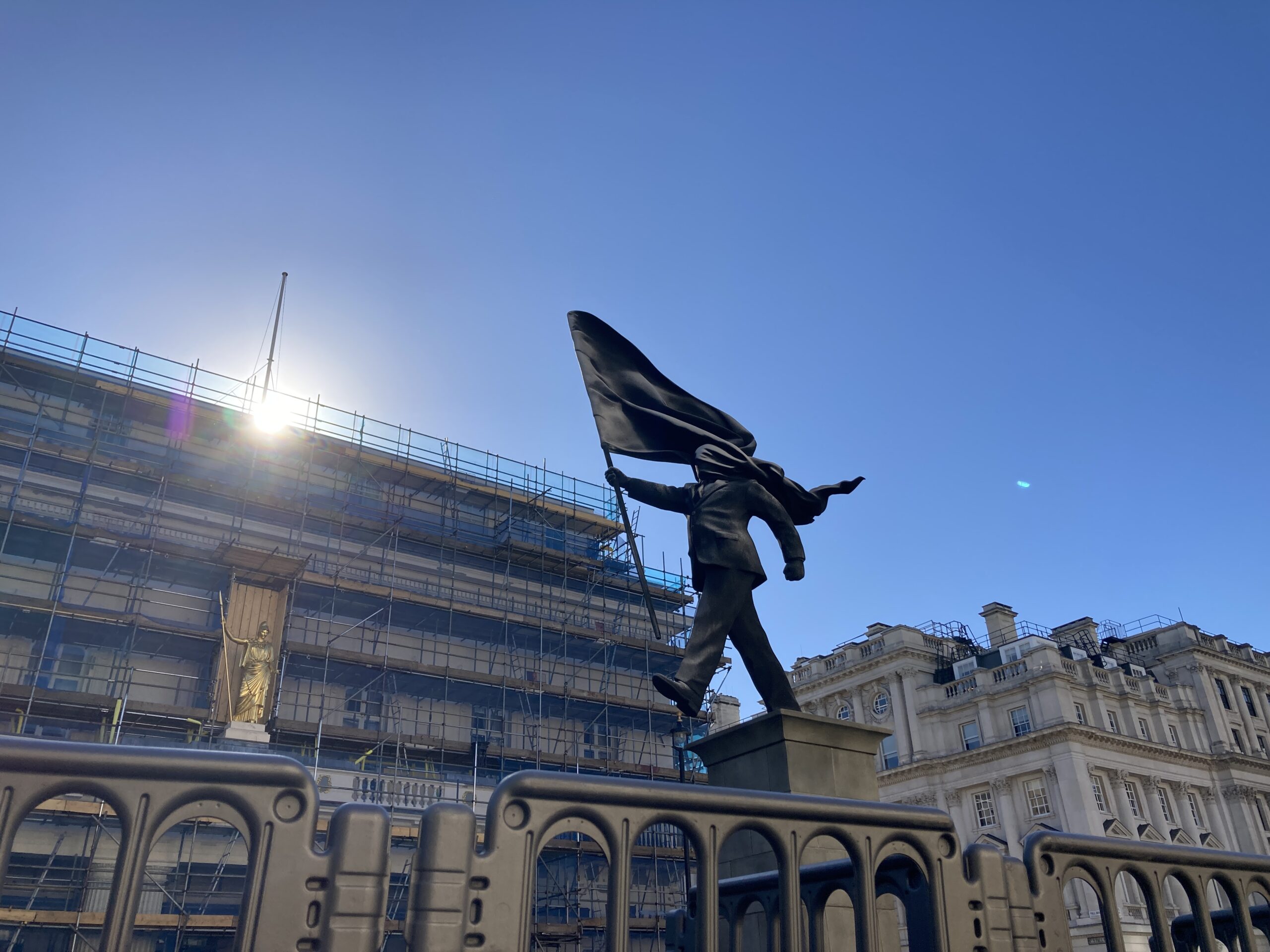

The Banksy Waterloo Place statue has become a test of what happens when unauthorized art turns into public property. Installed overnight in central London at the end of April, the sculpture shows a suited man stepping forward from a plinth while a large flag blows across his face. Banksy confirmed the work through his social media, but the city never commissioned it. Now Westminster City Council must decide whether the blinded figure is temporary disruption, permanent monument or an expensive problem that cannot be ignored.
The question has sharpened because ownership now sits with the council as landowner. In August, the council said it was reviewing short-, medium- and long-term options after spending almost £60,000 on safety barriers, administration and a guard. Public art becomes political the moment someone must decide whether it stays. Here, that decision also determines how an unsanctioned gesture enters the official story of London.
A monument that behaves like a warning
The sculpture borrows the visual language of authority. Its suited figure, raised plinth and darkened surface echo the historic monuments around Waterloo Place. Nearby are memorials and statues tied to monarchy, war, empire and public service. Banksy’s intervention initially appears to join that official company.
Then the composition breaks rank. The man does not stand securely. One foot moves beyond the edge. The flag he carries does not identify or protect him; it blocks his sight. The material illusion of permanence is paired with an image of imminent error. The work can be read as a satire of blind patriotism, but its strength lies in how little explanation it requires.
The city as an unwilling curator
Museums choose what enters their collections. Here, the sequence ran backward. The artwork arrived first, gathered crowds, demanded protection and only then produced an institutional decision. The city is being forced to curate an object it never selected.
That reversal is central to Banksy’s public practice. Unauthorized placement is not simply a delivery method; it is part of the work. The location supplies political and visual context, while the reaction becomes a second act. Fences, guards, cleaning attempts, official statements and tourism all accumulate around the original gesture.
What does preservation cost?
Recent reporting has placed the statue inside a wider debate about nearly £150,000 in public costs connected to three Banksy works in London. The Waterloo Place figure accounts for almost £60,000 of that sum. Critics see an artist imposing expenses on taxpayers. Supporters point to accessibility, debate and cultural tourism.
Both positions reveal a paradox. If the sculpture were ignored, it could be damaged or create a safety risk. If it is protected, unauthorized art receives public resources and a form of official endorsement. If it is removed, the city may be accused of erasing an artwork that people already regard as part of the place. There is no neutral action.
Can a disruption become heritage?
Banksy’s figure was designed to interrupt the surrounding order, yet permanence could change its meaning. Over time, a satirical object can become another monument on a tourist route. Its initial shock is replaced by familiarity, maps and souvenir photographs. Preservation saves the material work but may soften the challenge.
Temporary display has its own power. An artwork can matter because it appears, changes how a place is read and then disappears. Yet this sculpture has already crossed a threshold. The council owns it, the costs are documented and the public recognizes it. Whatever London decides will become part of the artwork’s history.
The blinded man seems to step forward without seeing what comes next. The city is now in the same position.
Sources
Continue reading: RM Opens His Private Art Collection to the Public at SFMOMA · Los Angeles Opens a Museum Shaped Like a Story