
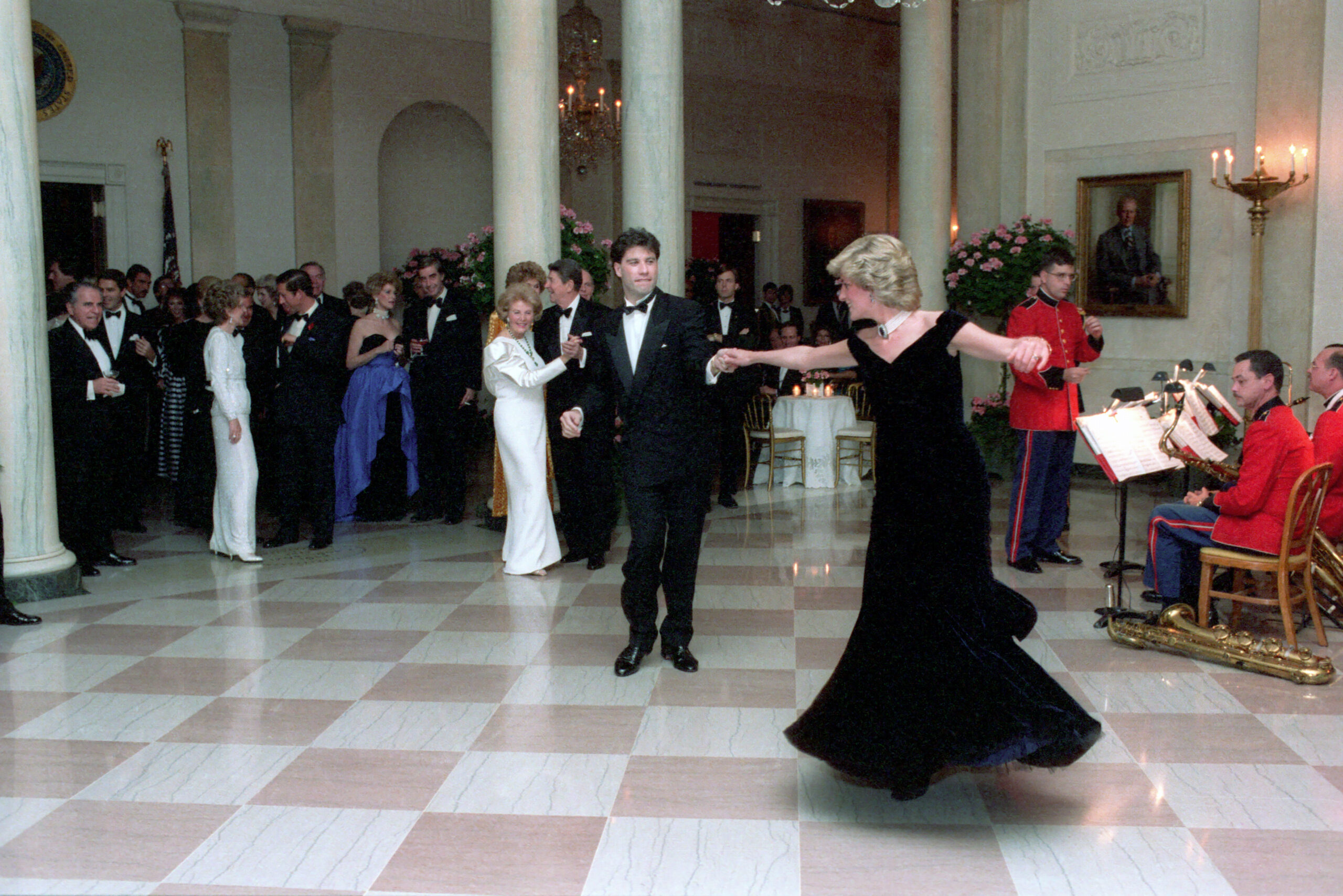

Princess Diana’s Travolta dress is returning to the spotlight at precisely the moment when fashion history is learning to speak in a more intimate voice. On November 7, the Ronald Reagan Presidential Library and Museum will open Diana: Love Life Legacy — A Life of Giving, an exhibition bringing together more than 700 artifacts connected to the princess’s public and private life. The midnight-blue velvet gown she wore while dancing with John Travolta at the White House in 1985 will be one of its emotional anchors.
The dress is already one of the most recognizable garments of the late twentieth century. Yet the exhibition’s promise is not simply that visitors will see it again. For the first time, Diana’s objects will be paired with material from the Reagan archive, allowing a famous image to be understood as part of a real evening of diplomacy, choreography and carefully constructed public presence.
The night a gown learned to move
Designed by Victor Edelstein, the velvet gown was made for movement. Its off-the-shoulder neckline creates a strong horizontal line, while the long skirt expands outward as Diana turns. In still photographs, the fabric seems almost black. Under the White House lights, however, it reveals deep blue folds that gather and release around the body. That tension between darkness and reflected light is what makes the dress cinematic.
The Reagan Library lists the gown alongside the invitation to the 1985 White House state dinner. The pairing matters. It reminds us that an iconic fashion image is rarely accidental. Architecture, protocol, photography, music and timing all participate. The Cross Hall became a stage; the state dinner became a performance; the dress became the visual element that held the composition together.
Why the photograph still feels alive
The famous dance has survived because the image contains a complete narrative. Two figures face one another while the gown sweeps between them. The surrounding guests form a quiet frame, turning their attention toward the couple. Nothing in the picture needs explanation before it creates feeling.
That clarity helps explain why Diana remains such a powerful subject for fashion exhibitions. She understood that clothes could communicate before a speech began. A soft blouse might reduce the formality of a hospital visit. A sharply tailored suit could signal confidence. An evening gown could honor ceremony while still conveying personality. Her wardrobe was not separate from her humanitarian work or public role; it was one of the languages through which that work became visible.
More than a celebrity wardrobe
The exhibition is scheduled through May 31, 2027, and will include internationally known garments, letters, jewelry, childhood objects and historic documents. Among the announced pieces are the Black Sheep sweater, the Caring dress worn during hospital visits, wedding slippers, Lady Dior bags and the last gown Diana tried on before her death.
Together, these objects can resist the flattening effect of fame. The Travolta dress represents spectacle, but a handwritten letter carries a different scale of attention. A childhood keepsake changes the rhythm again. Moving among them, a visitor can encounter Diana not as one fixed image but as a person whose identity was continuously negotiated through family, duty, media and compassion.
When fashion becomes cultural memory
This year marks twenty-nine years since Diana’s death in Paris. The anniversary guarantees renewed attention, but nostalgia alone does not explain her continuing influence. Diana’s image remains active because it changed how public figures use vulnerability, informality and clothing. Designers still reference her silhouettes; younger audiences rediscover individual looks without having lived through the original events.
The Travolta dress demonstrates how fashion crosses into art. Its material is velvet, but its lasting medium is memory. The object, the body and the photograph cannot be separated. When the gown goes on display in November, it will be motionless behind museum boundaries. Yet almost everyone who sees it will imagine it turning.
Sources
Ronald Reagan Presidential Foundation and Institute
U.S. National Archives catalog record
Continue reading: How Queen Elizabeth II Designed Visibility · Pope Leo XIV and the Return of Symbolic Dressing · The Enigma of Alexander McQueen: When Fashion Met Art