
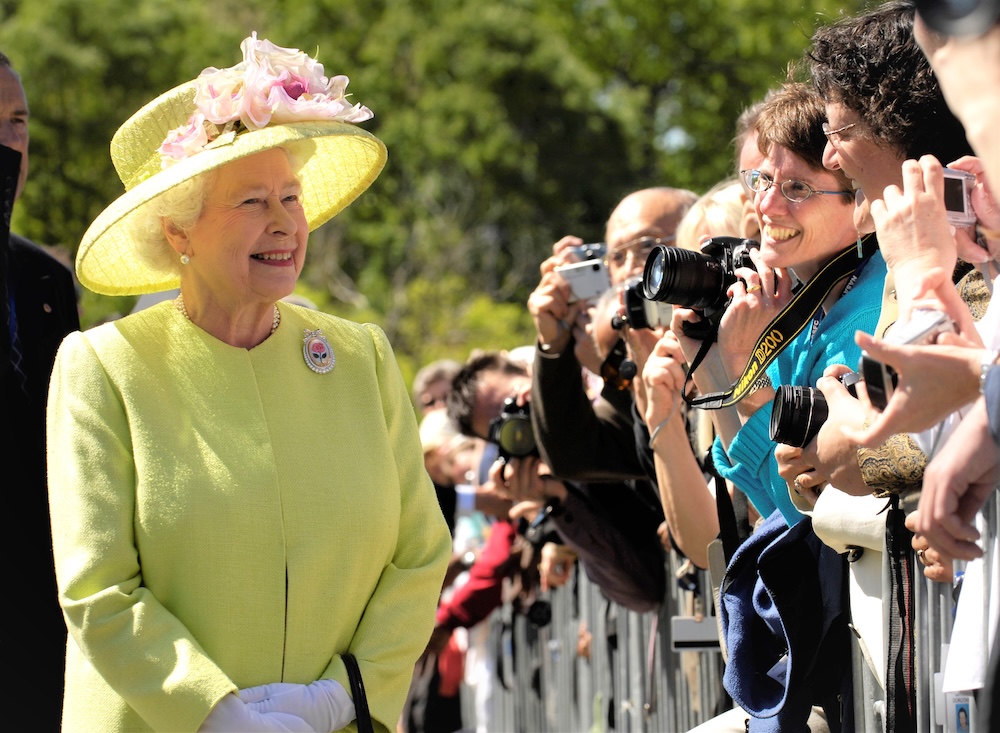

Queen Elizabeth II understood a principle every public artist eventually learns: visibility is designed. At five feet four inches, moving through crowds measured in thousands, she could not rely on chance. Color, hats, hems, clear umbrellas, weighted skirts, and carefully placed brooches became a visual system built to keep one small human figure legible at ceremonial scale.
Queen Elizabeth II: Her Life in Style, at The King’s Gallery beside Buckingham Palace, gathers more than 300 garments and fashion objects from her archive. Opened for the centenary of her birth, the exhibition was extended because of demand. It is the largest presentation of her wardrobe ever staged, but the real subject is not quantity. It is communication.
Clothing written for distance
The late Queen’s famous blocks of bright color were not simply cheerful taste. They allowed people standing many rows back to locate her. A matching hat completed the vertical signal. Hemlines were set for stairs, cars and wind. Weights were sewn into skirts. Sleeves and gloves accounted for handshakes repeated across hours. The wardrobe was a piece of mobile public design.
One of the most intelligent objects in the exhibition is transparent: the clear plastic raincoat. A conventional dark coat and umbrella could erase the wearer from the very public she had come to meet. Clear material protected the body while preserving the image underneath. Function did not interrupt symbolism; it served it.
Royal Collection Trust curator Caroline de Guitaut has emphasized Elizabeth’s hands-on role in the process. Design sketches, fabric samples and correspondence reveal that she understood what clothes could do. This was not a passive mannequin receiving instructions. The wearer knew the conditions of her work and helped engineer the answer.
Visibility is designed.
Embroidery carrying a nation
The Coronation dress, created by Norman Hartnell for June 2, 1953, remains the supreme example. Its ivory silk was embroidered with emblems representing the United Kingdom and Commonwealth countries: rose, thistle, leek, shamrock, maple leaf, silver fern, wattle, protea, lotus, wheat, cotton and jute. The garment turned botanical motifs into a political map worn on the body.
That map belonged to its time, including the unequal histories and imperial structures that ceremony often smooths into splendor. Looking seriously means holding the craft and the power together. Embroiderers translated state symbolism into thread, pearl, crystal and color. Their labor made an abstract institution visible as surface.
The exhibition also follows a life through christening robe, bridesmaid dress, wedding dress, off-duty clothes and diplomatic ensembles. Ten decades of clothing show a person becoming an office, then learning how to remain a person inside it.
The soft power of consistency
Fashion often celebrates reinvention. Elizabeth practiced recognition. The coat-and-dress ensemble, structured hat, gloves, handbag and brooch created continuity through enormous social change. That consistency reassured some viewers and represented authority to others. It also made subtle variation more powerful. A brooch connected to a country, a color selected for an event, or embroidery carrying a local flower could deliver a message before a speech began.
I am moved by the seriousness given to practical details. Creative people sometimes believe vision lives only in the grand gesture. Here, vision lives in a hem that will not fly up, a transparent layer that will not block a face, a hue visible from the back of a square. Care is scale-specific.
The archive includes garments, hats, shoes, jewelry, drawings, samples and handwritten exchanges. Together they dismantle the idea that iconic style is spontaneous. Behind every apparently effortless appearance stood designers, dressers, milliners, embroiderers and craftspeople solving physical problems.
That collective intelligence is what I would magnify. The image of a monarch may look singular, but it was made by many hands. Fashion carried protocol, weather, geography and memory at once.
The Queen once said that she had to be seen to be believed. Her wardrobe answered with color.
It made distance disappear.
The exhibition’s extension confirms that audiences recognize clothing as historical evidence. A sleeve can record protocol; a sample can preserve a negotiation; a hat can explain how one face remained visible through decades of public ritual. These objects deserve the same close looking we give painting and sculpture because they shaped lived perception on an international stage.
Continue reading: Princess Diana’s Travolta Dress Is Ready to Dance Again · Pope Leo XIV and the Return of Symbolic Dressing · The Enigma of Alexander McQueen: When Fashion Met Art